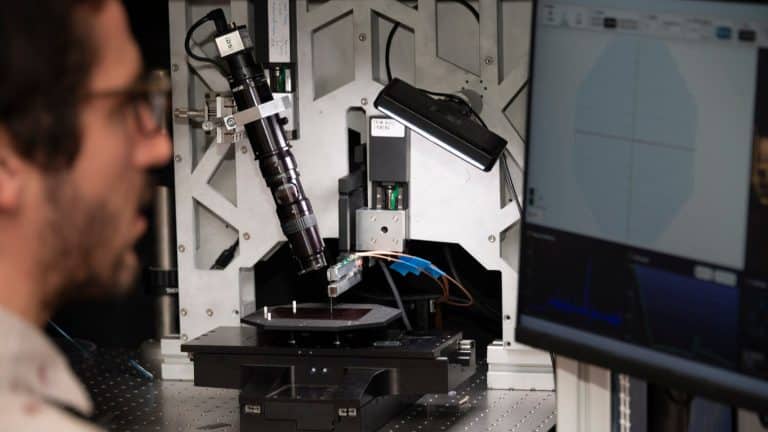

Modern electronic devices rely on microscopic precision. Every thin film transistor and every conductive trace on a silicon wafer must function flawlessly. Yet in semiconductor fabrication and display manufacturing, defects are inevitable and costly. To meet these challenges, microprinting technologies are emerging as key enablers of defect repair, performance enhancement, and advanced functionality across next-generation electronic systems.
Understanding Semiconductor & Display Defects in Modern Manufacturing
What Are Semiconductor Open Defects?
A semiconductor open defect occurs when a conductive path breaks during the fabrication process. During deposition, photolithography, or etching, missing material or particle contamination can sever a circuit. These defects in semiconductors fall into two categories:
- Extra material defects causing shorts: This type of defect happens when too much conductive material is present where it shouldn’t be. The unwanted material connects two paths that should stay separate.
- Missing-material defects causing opens: This happens when conductive material is missing where it should be. The circuit path is broken.
A single open on an integrated circuit can render an entire die nonfunctional, directly killing yield.
Common OLED and Display Defects: Dead Pixels, Dark Spots & TFT Failures
In TFT LCD panels, the array process is the first critical phase of manufacturing. It includes gate electrode formation, semiconductor layer deposition, and source and drain patterning. Defects at any step cascade into visible failures on the finished panel.
OLED displays are even more sensitive. A damaged organic layer or broken electrode produces dead pixels, dark spots, or uneven brightness across the active matrix. Automated optical inspection and electron microscopy help identify these issues, but detection alone does not solve them.
The Economic Impact of Defects on Semiconductor & Display Yield
- Up to 30% of OLED screens produced annually are rejected due to microscopic defects, roughly €16 billion in losses.
- Advanced fabs now exceed $20 billion in construction costs.
- Major display manufacturers in Japan, China, and South Korea face constant pressure to improve quality control and yield.
Why Traditional Defect Repair Methods Fall Short
Limitations of Inkjet Printing, Laser Repair and CVD
- Laser repair is a subtractive method; it removes material rather than adding it. That makes it unsuitable for open defects where material is missing. It also risks thermal damage to sensitive electronic devices.
- Inkjet printing is an additive approach but lacks resolution for modern high-precision circuits. Satellite drops and particle contamination further limit accuracy.
- Chemical vapor deposition delivers excellent material quality but deposits across broad areas, requiring additional masking and deposition photolithography steps.
These methods were designed for larger feature sizes.
Micro Printing: A Breakthrough in Semiconductor Defect Repair
How Direct-Write Additive Manufacturing Enables Sub-Micron Repair
Micro printing takes a fundamentally different approach. Direct-write additive manufacturing places functional material exactly where needed. A micropen deposits conductive, dielectric, or semiconductor ink directly onto the defective surface in ambient conditions. It works on glass substrates, flexible films, and 3D surfaces.
Rather than scrapping an entire panel, manufacturers perform targeted, real-time repair on the production line. This enables significant semiconductor yield improvement at an industrial scale.
HPCaP Technology: Precision, Speed and Versatility
At the forefront of this revolution is Hummink’s High Precision Capillary Printing (HPCaP). This technology uses capillary forces (not external pressure or lasers) to control ink deposition. A macro-resonator oscillating at ~1 kHz stabilizes the meniscus between the micropen and substrate, enabling precise material placement.
HPCaP prints metallic lines as narrow as 1 μm, fine enough to repair defects in semiconductor circuits and TFT arrays. It also supports inks from low-viscosity conductive formulations to high-viscosity polymers. The system repairs microdefects in under two seconds per defect, and its fully modular NAZCA system integrates directly within existing fabs. Unlike conventional methods, HPCaP technology reshaping high-resolution applications eliminates satellite drops, splashes, and impurities entirely.
Key Applications: From OLED Repair to Advanced Packaging
Repairing TFT Array Defects in Next-Generation Displays
Each thin film transistor in a display’s active matrix controls one pixel. When a defect disrupts that function, the pixel fails. HPCaP deposits conductive ink with sub-micron accuracy to restore damaged gate, source, or drain lines. This method of OLED repair through additive microfabrication lets manufacturers salvage panels otherwise destined for scrap. Early testing with major display manufacturers suggests yield boosts of around 10%.
Semiconductor Packaging: Fixing RDL Defects and Missing Bumps
In advanced packaging, HPCaP addresses redistribution layer defects and missing solder bumps by printing high-density microbumps below 5 μm in a single step. This matters for next-generation memory and high-performance computing, where repairing open defects in semiconductors at the packaging level directly impacts device reliability.
Biosensors, Flexible Electronics & Printed Electronics
HPCaP also enables biosensor fabrication with submicron electrode gaps for medical devices. For flexible electronics, it prints onto pliable substrates under ambient conditions, ideal for wearable devices. Furthermore, the approach to sustainable manufacturing with HPCaP reduces material waste across printed electronics applications.
The Future of Defect Repair in Semiconductor & Display Manufacturing
Defect analysis, inspection systems, and process control have all advanced. But actual repair at the point of failure has lagged behind. Microprinting closes that gap. Machine learning combined with real-time defect detection will expand these capabilities further across integrated circuits and advanced displays.
Hummink’s vision is to embed sub-micron printing directly within global manufacturing lines, transforming how flaws in TFT and advanced display manufacturing are corrected. As display repair and LED display production grow more complex, microprinting is no longer emerging. It is a proven, industrial-grade solution for modern electronics.