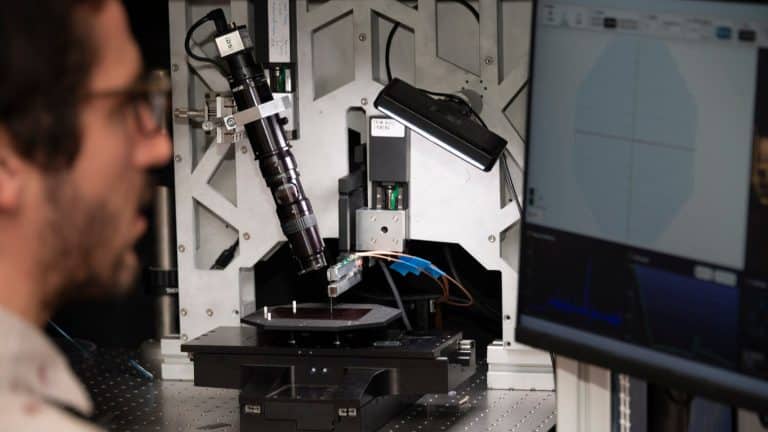
Every year, manufacturers face significant yield losses due to microscopic defect formation on PCBs, multilayer circuits, and advanced electronic devices. When a trace breaks or a conductive ink deposit degrades, replacing the entire board becomes costly and time-consuming. This is where micro-printing for circuit repair stands out.
What is micro-printing in electronics?
Definition of micro-printing
Micro-printing describes an additive printing process capable of depositing conductive ink, polymers, or metal-based materials at a micro or nanoscale. The technique restores single layers, reconnects broken trace patterns, and reinforces electronic structures without applying excessive heat to the board (with the exception of laser sintering processes).
Applications in electronic circuits
Engineers rely on it to repair microscopic defects occurring on multilayer pcbs, logic boards, and advanced electronic components. It rebuilds copper wire paths and patches localized defect zones in devices where traditional solder-based methods are too limited or too damaging. This approach is also increasingly used in printed electronics, display repair, and semiconductor fabrication. For challenges related to defects, see our article about defect solutions.
Benefits of micro-printing for electronic circuit repair
Precision in repairing micro-components
It reconstructs broken trace features with submicron precision, restoring circuit performance without disturbing adjacent layers. Its controlled deposit of conductive ink suits dense pcb and semiconductor designs where one defect can reduce yield.
Cost-effectiveness and time-saving
Instead of replacing full boards, engineers rebuild only the damaged zone. This improves production yield by repairing defects that would otherwise be deemed irreparable, reducing material waste and limiting downtime across even the most advanced electronic systems.
Minimizing risks of damage
The ink is deposited at room temperature, preserving sensitive components during the printing stage. Sintering is then required to achieve conductivity — typically through oven sintering at around 200°C, or laser sintering when localized heat application is needed to protect heat-sensitive substrates.
Core micro-printing techniques for circuit repair
Additive micro-printing (material deposition)
This method selectively deposits conductive ink or metal at a micro scale to rebuild broken circuit paths. It suits multilayer pcbs, enabling controlled material placement without stressing deeper layers.
Laser-assisted micro-printing
Laser sintering can be combined with capillary micro-printing to achieve localized heat application, enabling conductivity without exposing the full substrate to high temperatures. A separate laser-based approach, laser-assisted CVD (Chemical Vapor Deposition), also exists as an alternative metal deposition method – though it typically offers lower precision than capillary-based micro-printing.
Inkjet and 3D micro-printing approaches
These printing methods eject droplets or 3D structures to restore functional patterns. They address defect correction on flexible boards and small components, though their accuracy is typically more limited than advanced additive tools.
Challenges and solutions in micro-printing for repairs
Alignment and accuracy issues
Repairing micro-scale circuit features requires precise positioning. Slight misalignment affects trace continuity and overall performance, especially on multilayer pcbs.
Material adhesion and conductivity challenges
Deposited ink must adhere correctly and maintain stable conductivity. Variations in surface energy or material compatibility can limit the reliability of the repair.
Technological solutions and best practices
Advanced printing technologies, controlled deposit parameters, and improved functional materials enhance accuracy, adhesion, and long-term quality, reducing risks of recurring defect formation.
Latest innovations in micro-printing technology
High-resolution printing for nano-circuits
Recent systems achieve sub-micron resolution, enabling repairs on dense semiconductor structures and advanced electronic components, though reaching this level of precision remains technically demanding.
Integration with automated repair systems
This increases efficiency, stabilizes yield, and ensures repeatable deposit quality across high-volume workflows.
Emerging materials for enhanced durability
New conductive ink, metal–polymer blends, and high-adhesion coatings support complex design and extend repair reliability on rigid or flexible PCB surfaces.
Micro-printing vs traditional repair methods
Speed and efficiency comparison
Traditional solder-based repair methods require heating, manual alignment, or partial board replacement. Micro-printing delivers faster, localized deposits of conductive material, restoring circuit features with minimal interruption to production.
Cost and resource implications
By targeting only the damaged trace or layer, micro-printing reduces cost and limits waste. It avoids replacing full pcb sections, a common outcome when defects occur in dense circuitry.
Reliability and long-term performance
Additive printing technologies ensure stable conductivity and lower thermal stress, improving long-term reliability compared to traditional rework, especially on advanced or multilayer electronic devices.
Future outlook: the role of micro-printing in electronics maintenance
Predictions for widespread adoption
As electronic systems grow in density, it becomes essential for restoring circuit functionality at the micro- and nanoscale, a requirement increasingly shaped by advances in nanoscale fabrication. Its precision and low-impact process make it suitable for next-generation semiconductor and pcb architectures.
Impact on electronics manufacturing and repair
Manufacturers integrate micro-printing into production and testing systems to stabilize yield, reduce waste, and support the development of more complex designs. This trend already shapes advanced display workflows, particularly in OLED repair, where precise additive deposition enhances defect correction and long-term panel performance.
FAQ on micro-printing for circuit repair
Can micro-printing fix any type of damaged circuit?
It repairs most trace breaks and micro-scale defect zones, especially on multilayer pcb and semiconductor structures.
How long does a micro-printed repair last?
Durability depends on material and conductivity, but performance is comparable to the original layer.
What equipment is required?
High-precision additive printing technologies with controlled deposit tools.
Is micro-printing suitable for mass production repairs?
Yes, it integrates into automated production for stable yield improvement.