

In this article, we explore High Precision Capillary Printing (HPCaP), a breakthrough technology enabling this new level of performance. We will explain how it works, how it compares to traditional printing methods, and how it is already being used across bioelectronics, bioprinting, and advanced medical device manufacturing. Finally, we will look at real-world research applications and the future potential of HPCaP.
What Is HPCaP? A Brief Overview of the Technology
How Capillary Forces Enable Sub-Micron Printing
HPCaP operates by guiding functional inks through a precision-engineered capillary tip. Controlled capillary forces and resonance drive the material onto the target surface and achieve line widths and feature gaps as small as 500 nm.
Unlike pressure-based or droplet-ejection systems, capillary printing avoids satellite drops. The result is a clean, high-resolution deposition with exceptional accuracy and reproducibility. This level of control is essential for the demanding design requirements of medical devices. It also simplifies inspection by producing consistent, defect-free patterns.
HPCaP vs. Traditional Printing Technologies (Inkjet, Screen Printing)
- Inkjet printing is commonly used in electronics and healthcare manufacturing. However, it is limited by droplet size, typically producing features above 10 µm.
- Screen printing offers high-speed production but lacks the resolution for micron-scale patterns.
Both methods struggle with material compatibility on flexible substrates. Neither method delivers the yield or consistency required for chip-level bioelectronic fabrication. High-Precision Capillary Printing technology overcomes these barriers. It delivers sub-micron accuracy across diverse surfaces without masks or molds. This performance gap positions HPCaP as the superior tool for advanced biomedical applications.
HPCaP Applications in Bioelectronics and Biomedicine
High-Precision Biosensors: From EGOFETs to Wearable Health Monitors
The healthcare industry is moving toward personalized medicine and real-time patient monitoring. This shift requires biosensors with unprecedented sensitivity and precision. Healthcare providers need devices that deliver accurate data at the point of care. HPCaP technology meets this need through biosensor manufacturing with HPCaP.
At Université Paris Cité, the ITODYS laboratory developed transistor-based biosensors using HPCaP. The team printed EGOFETs with electrode gaps as small as 500 nm. These sensors detect minute changes in the body’s biochemistry with high sensitivity. They provide data that directly informs treatment decisions and improves patient care. This level of quality in biosensor performance is critical for disease management.
HPCaP also enables integration into wearable health monitors for continuous use. Flexible substrates allow the sensors to conform to the body’s contours; such systems could reduce medical expenses by enabling early detection in primary care settings.
Bioprinting Living Cells: Microbial Communities and Tissue Engineering
One of the most promising aspects of HPCaP in healthcare is bioprinting. The technology can precisely deposit living cells alongside functional materials. This opens new possibilities in tissue engineering and microbiome research.
At Imperial College London, Dr. Ravinash Krishna Kumar explored HPCaP for bioprinting. His team focused on building spatially structured microbial communities. Understanding the structure of these cell communities is fundamental to infectious disease research. The challenge was printing cell patterns with diameters below 50 micrometers; traditional printing equipment could not achieve the required high resolution. Working with Hummink, the team successfully printed E. coli bacteria in various patterns. This advance supports therapy development targeting specific pathogens. The ability to control cell placement at this level strengthens clinical research programs.
Flexible and Implantable Medical Devices
Modern medicine increasingly relies on flexible and implantable devices. These include
- Neural interfaces
- Drug delivery patches
- Diagnostic implants.
HPCaP supports their design and development through high-precision printing on flexible substrates.
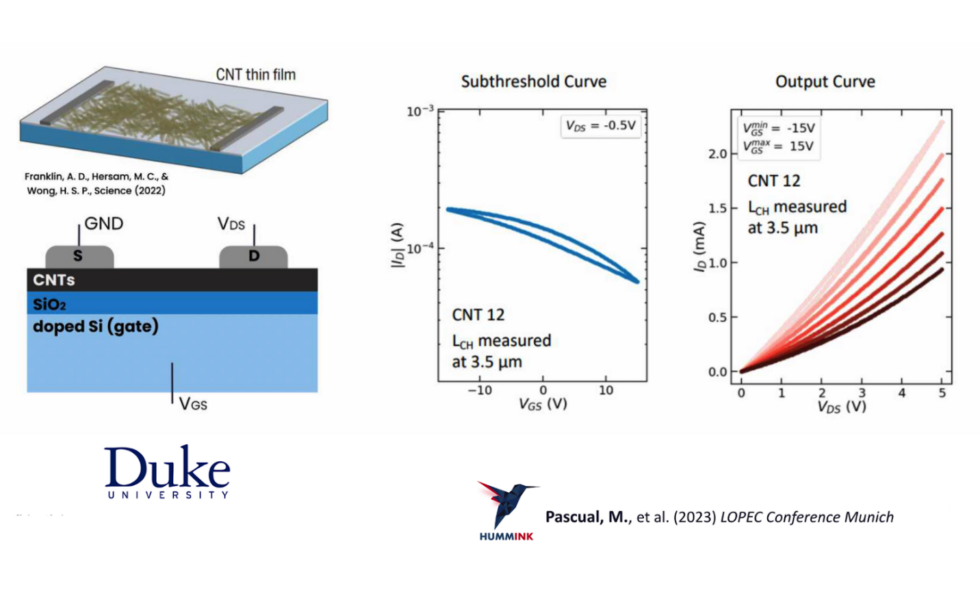
At Duke University, Dr. Aaron Franklin’s team printed silver electrodes with 500 nm gaps. They used HPCaP for carbon nanotube (CNT) transistors on silicon wafers. The team then expanded to flexible substrates like Kapton. This progression demonstrates HPCaP’s versatility for implantable device manufacturing. The ability to print conductive inks on conformable materials is critical; it enables the creation of medical devices that integrate with the human body. Such devices could support continuous health monitoring in community care settings. They also reduce the need for invasive procedures by providing surface-level diagnostics.
Real-World Research: How Universities Are Using HPCaP in Healthcare
HPCaP technology is already in use at leading research institutions worldwide :
- Duke University applies it for high-performance bioelectronic transistors.
- Université Paris Cité uses it for advanced EGOFET biosensor fabrication.
- Imperial College London explores its bioprinting capabilities for microbial communities. Hummink’s development has been supported by the European Innovation Council fund.
These partnerships demonstrate the technology’s versatility across healthcare applications. They also validate HPCaP’s performance for high-resolution applications of HPCaP in clinical and research settings. Each collaboration advances the development of next-generation medical devices and diagnostics. Hummink’s NAZCA system serves as the industrial printing module supporting these research programs.
The Future of HPCaP in Healthcare: Drug Delivery, Regenerative Medicine & Beyond
The future applications of HPCaP in healthcare extend well beyond current use cases. Drug delivery systems represent a major opportunity for the technology. HPCaP could enable the printing of micro-structured drug carriers with precise dosage control. In regenerative medicine, the technology could support tissue scaffold fabrication. Printing biocompatible materials and living cells in controlled patterns is essential for this field. Advanced therapy approaches, including targeted treatment of disease at the cellular level, could benefit directly. Public health systems may also gain from scalable, low-cost biosensor production.
As the healthcare industry evolves, demand for precision manufacturing will continue to increase. HPCaP’s compatibility with diverse materials and substrates positions it for broad adoption. Integration with advanced imaging and quality control systems will further improve yield and performance. Cost reduction in medical device production is another key advantage for health systems globally. For R&D centers, hospital networks, and medical device companies, HPCaP offers a clear path forward. It combines the resolution, flexibility, and material range that future medicine demands. To explore how this technology applies to your research, contact Hummink for a demo.
FAQ: HPCaP on Healthcare — Common Questions Answered
What is HPCaP, and how is it used in healthcare?
HPCaP is High Precision Capillary Printing technology developed by Hummink. In healthcare, it fabricates biosensors, bioelectronic devices, and bioprinted cell structures. It achieves sub-micron resolution using capillary forces.
How does HPCaP improve biosensor manufacturing?
HPCaP prints electrode structures with gaps as small as 500 nm. This precision enables highly sensitive biosensors for real-time patient monitoring. It supports both rigid and flexible substrates for wearable devices.
Can HPCaP be used for bioprinting living cells?
Yes. HPCaP deposits living cells with high spatial accuracy. Researchers have used it to print E. coli bacteria in controlled patterns. This supports microbiome research and tissue engineering applications.
Which medical devices can be manufactured using HPCaP technology?
HPCaP supports biosensors, wearable health monitors, flexible neural interfaces, and diagnostic implants. Its versatility with conductive inks and biocompatible materials enables diverse device fabrication.
How does HPCaP compare to traditional biomedical printing technologies?
Inkjet and screen printing lack the resolution for sub-micron biomedical features. HPCaP achieves 500 nm precision without satellite drops or masks. It also supports a broader range of materials and substrates.
What future applications could HPCaP enable in medicine and healthcare?
Emerging applications include micro-structured drug delivery systems and tissue scaffold printing. HPCaP could also advance regenerative medicine through controlled deposition of living cells and biomaterials.


