This article explores what microprinting is, how it works, and why it has become a cornerstone of document security and industrial innovation. We’ll look at its origins in stamps and currency, its printing technology, common applications, and the emerging trends shaping its future across various industries.
Microprinting definition and origins
Microprinting refers to the process of printing extremely small letters or words, usually less than 0.3 millimeters in font size. They appear as a solid line to the naked eye but become readable under a magnifying glass. First introduced on U.S. stamps in 1992 and later adopted on currency, this security feature was developed to make it difficult to reproduce official documents using standard printers or scanners.
Today, thanks to additive and digital microfabrication, microprinting extends far beyond letters. It includes:
- micro patterns or microdots forming images or optical effects,
- logos, serial codes, or micrographic textures embedded into paper, films, or semiconductors,
- even functional structures (conductive lines, contact pads, and polymer features) printed at the micrometer scale in electronics or optics.
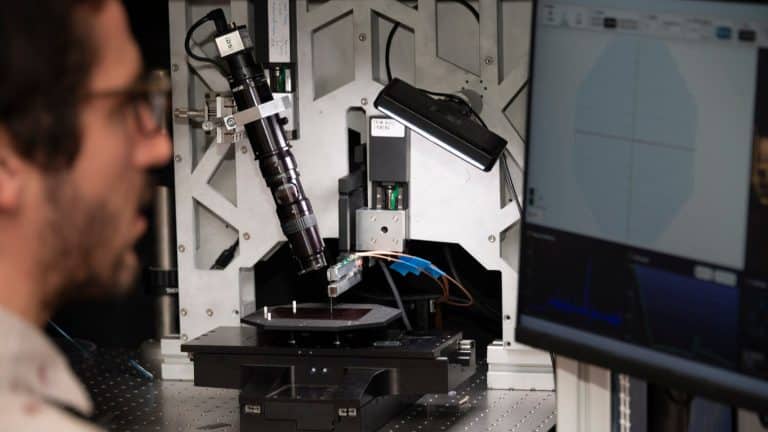
Breakthroughs in Additive Manufacturing in Micro and Nanoscale have pushed the boundaries of what can be printed. A good example is Hummink’s HPCaP process, often described as the “World’s Smallest Fountain Pen,” which uses capillary forces to deposit materials with unprecedented precision.
How does microprinting work?
Microprinting relies on advanced printing technology such as offset printing, intaglio, or digital techniques capable of producing microscopic characters with high precision.
Depending on the design, the microprint can be positive (dark text on a light background) or negative (light text on a dark background). These patterns, printed with specialized ink, are difficult to reproduce accurately.
In modern manufacturing, additive and digital microprinting apply the same principles at the micrometer scale to print functional structures like conductive lines or polymer layers.
Common applications of microprinting
Microprinting in currency and documents
These High Precision Printing Solutions are used in the following applications to verify authenticity and prevent fraud :
- banknotes
- checks,
- government documents…
Product security and anti-counterfeiting
The Innovative Micro-Printing for Packaging enhances protection. Brands integrate microprinting with security threads, holograms, and QR codes to protect packaging and cards.
Other industrial applications
In electronics, additive microprinting enables precise ink deposition on micro and nanoscale circuits. Discover Microscale and Nanoscale Fabrication with HPCaP with Hummink’s HPCaP technology. For more detailed information, visit the FAQ on HPCaP to explore additional questions about microprinting and additive fabrication.
Benefits and advantages
- Microprinting increases security by creating details invisible to the naked eye and nearly impossible to copy.
- It offers high durability, integrates easily into production workflows, and is more cost-effective than complex holographic solutions.
- Its authenticity verification is human-readable yet compatible with digital verification tools for automated inspection.
Challenges and limitations
Despite its precision, microprinting faces several constraints:
- Requires specialized equipment and precise alignment.
- Materials and inks can affect durability and readability.
- Verification often needs magnification or digital inspection tools.
- Scaling the process increases costs and complexity in production.
The future of microprinting
Recent innovations are shaping the next generation of microfabrication in several key ways:
- Integration with additive manufacturing allows the creation of functional microstructures and electronic components that bridge design and production at the microscale.
- Advanced processes such as aerosol jet and two-photon polymerization now enable smaller, multi-material features used in displays, sensors, and micro-optical systems.
- In display manufacturing, Hummink’s TFT and Advanced Manufacturing demonstrates how microprinting redefines thin-film fabrication with submicron accuracy.
- The same HPCaP technology supports additive repair in OLED components, as detailed in OLED Repair through Additive Microfabrication, improving efficiency and extending the life of high-value electronic systems.
- In semiconductor manufacturing, Micro-Printing for Semiconductor Display Defects highlights how precision deposition can correct or reinforce delicate display layers during fabrication.
Frequently asked questions about microprinting
Is microprinting the same as nanoprinting?
No. Microprinting operates at the micrometer scale, while nanoprinting works below 100 nm and is used in semiconductor fabrication.
Can microprinting be replicated or forged?
Not easily. Even high-end digital printers fail to reproduce the fine patterns or characters accurately.
How can businesses integrate microprinting?
By coordinating design, font, and printing technique early in production