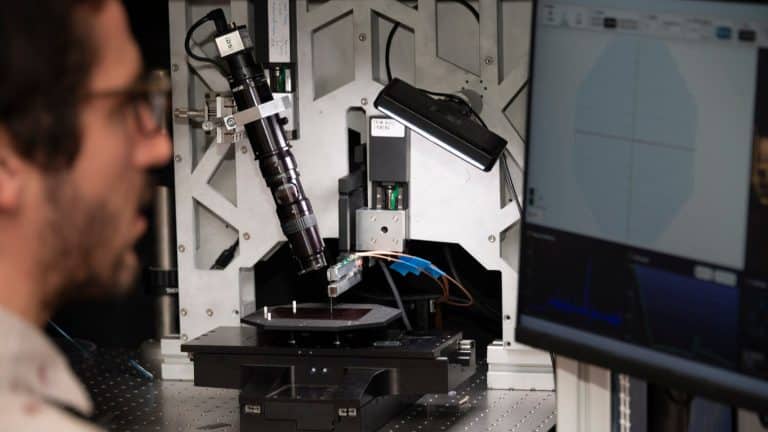

This article explains what microfluidic micro-printing is and how it works. It covers the core principles behind the technology, the printing methods involved, and the level of precision these systems can reach.
What is microfluidic micro-printing? Definition and core principles
Microfluidic micro-printing brings together microfabrication and additive manufacturing at the microscale. In microfluidic systems, tiny volumes of fluid flow through channels only tens to hundreds of micrometers wide. Lab-on-chip and diagnostic devices use these miniature channels to mimic lab processes on a single chip.
What is micro-printing ?
It refers to printing techniques (like micro-3D printing) that create these channels and structures with very fine resolution. 3D-printing technologies can monolithically build complex microdevices in one step. This means an entire fluidic network is printed as a single part, without needing to align or bond multiple pieces.
How Microfluidic Micro-Printing Works
In practice, microfluidic micro-printing uses methods such as projection stereolithography or inkjet printing to deposit materials with micron-scale control. For example, two-photon polymerization can fabricate sub-micron features and even print embedded nozzles inside sealed channels.
Material Deposition and Feature Formation
These printing processes rely on precise handling of very thin liquid inks or resins. A small pressure or laser pulse forms a tiny jet or droplet. The jet solidifies into a channel wall or structure layer by layer. Features as small as a few micrometers can be achieved. In effect, microfluidic micro-printing is an additive, digitally driven way to build microdevices. It overcomes many limitations of traditional microfabrication by enabling free-form, 3D channel geometries rather than just flat, planar structures.
High-Precision Micro-Printing Techniques
High precision Printing solutions demands ultra-precise control. Specialized printers use thin glass nozzles or focused lasers to deposit material with sub-micron accuracy. For instance, Hummink’s HPCaP (High Precision Capillary Printing) uses a microcapillary held by a macroresonator to deposit materials on demand. This method is sub-micrometer in resolution and works on any substrate, even flexible or 3D surfaces. Hummink’s Microtechnology Foundations and Applications resource explains how micro-science and engineering of 1–1000 μm devices underpins this field.
Key applications in research and industry
Biomedical Research and Lab-on-Chip Devices
- Microchips can be printed with complex fluidic networks that culture cells or run chemical assays. For example, three-dimensional microfluidic chips have been used for single-cell analysis and microtissue culture. These devices can trap cells and perform automated mixing, separation, or sensing on a small scale.
- Printed microfluidic sensors and lab chips are being developed for rapid blood tests, PCR-based diagnostics, and point-of-care screening. Some chips can detect biomarkers or viral RNA in minutes, greatly speeding up test results compared to standard lab equipment.
- Microfluidic micro-printing also serves drug discovery. Pharmaceutical labs use printed micro-reactors to test new compounds on tiny samples. The ability to print complex channel networks enables parallel experiments and high-throughput screening on a single chip.
Advanced Electronics and Photonics
As devices shrink, integrating microfluidic cooling or signal routing becomes important. Engineers are exploring microfluidic cooling channels etched into CPU or AI chips to dissipate heat efficiently. Micro-printing allows custom channel designs that fit around hotspots. Additionally, high-density interconnects and circuit elements can be fabricated via micro-printing.
In photonics, micro-printed waveguides and micro-lenses are being integrated onto sensor chips.
Environmental Monitoring, Energy, and Soft Robotics
- Printed microfluidic devices can sample air or water through on-chip filters and sensors. They are used in wearable or portable devices for pollution monitoring.
- In energy, printed microchannel arrays can serve as microscale heat exchangers or miniaturized fuel injectors. Even emerging fields like soft robotics use microfluidic networks as tiny fluidic actuators.
Advantages over traditional microfabrication
Monolithic 3D Fabrication
Traditional microfabrication often builds devices in layers or cuts separate parts that must be aligned and bonded. By contrast, micro-printing can create complex 3D microchannel networks in one piece. This assembly-free approach drastically cuts development time. It also eliminates alignment errors between layers.
Design Freedom
Additive printing gives engineers complete design freedom to create intricate geometries. Printed devices can include curved channels, movable membranes, or integrated valves that would be very difficult or impossible with planar lithography. For example, researchers have printed 3D helical channels and on-chip valves.
Shorter Lead Times
Conventional processes like silicon micromachining or injection molding have long lead times and high tooling costs. Micro-printing greatly speeds up prototyping. A prototype chip can be printed in hours or days instead of weeks. Rapid iteration is possible because design changes just require re-sending digital print files, with no need to remake masks or molds.
Material and Process Flexibility
Printing can work with a variety of materials. Photocurable resins, silicones (like PDMS), and even some metals or ceramics can be deposited. Many printers allow mixing materials on the fly. For example, projection stereolithography provides high resolution with biocompatible resins, while extrusion printing can build rigid or conductive elements. In contrast, traditional microfabrication typically requires very clean conditions and is limited to specific substrates like silicon or glass.
Precision and Resolution
Modern microprinters achieve micron-level accuracy. Two-photon printers can even reach sub-micron resolutions. This high precision rivals or exceeds many conventional techniques.
Cost Efficiency for Small Runs
Since no expensive masks or tooling are needed, small-volume production is cost-effective. Traditional soft lithography or etching often requires expensive cleanroom setups. Micro-printing can be done on benchtop systems. This democratizes microdevice fabrication: even small labs or startups can prototype chips without big capital investment.
Overall, the precision, speed, and flexibility of microfluidic micro-printing make it an appealing alternative to traditional microfabrication. (For more on advanced microfabrication, see Hummink’s Microscale and Nanoscale Fabrication overview of emerging HPCaP techniques.)
Latest Innovations and Trends
Integration of Microfluidics into Printing Technologies
Microfluidic micro-printing is rapidly evolving with new techniques and hybrid approaches. One major trend is integrating microfluidics with printing technologies. Researchers have begun using microfluidic mixing devices as part of 3D printers.
Embedded Printing Inside Microchannels
Another innovation is embedded printing. Some teams have demonstrated printing functional components directly inside microchannels. In one case, a spinneret nozzle (12 µm tip) was 3D-printed in situ inside a channel to create a fiber-spinning system. This merging of printing and microfluidics allows “chips within chips” fully integrated microsystems.
Advances in Light-Based Micro-Printing
Advanced light-based printing continues to push resolution. Digital Light Processing (DLP) and Two-Photon Polymerization (2PP) printers have been adapted for transparent and very fine channels.
High-Precision Micro-Printers in Industry
In industry, the focus is on high-precision micro-printers. Companies like Hummink (using a capillary pen approach) are building micro-3D printers with 2–10 µm resolution. These tools let designers print electronics, photonics, and fluidics all on one platform.
Expansion of Printable Materials
The materials also keep expanding. Novel printable inks now include conductive silver, biocompatible polymers, and even living cells (for bioprinting vessels or tissues).
Digitally Driven Microfabrication and AI Integration
Overall, the trend is toward digitally driven microfabrication, where design, materials, and printing processes co-evolve. Artificial intelligence is being applied to optimize channel layouts and printing paths. For example, machine-learning design of bio-inspired channel patterns (like leaf-vein structures) has achieved improved microfluidic cooling in chips.
Current Challenges and Future Prospects
Despite its promise, microfluidic microprinting faces technical challenges:
- Resolution vs Throughput: printing extremely narrow channels (<50 µm) with high aspect ratios can clog or leave uncured resin behind. Pushing resolution also slows down print speed. Finding a balance between tiny feature size and practical printing time remains a key hurdle.
- Material Limitations: while PDMS and UV-curable resins are common, many microfluidic applications require materials that meet chemical and biological needs (e.g. glass-like transparency, or materials that do not swell in solvents). Developing new printable materials (inks) with the right properties is ongoing work.
- Surface Roughness and Channel Finish: many printing processes leave rough channel walls that cause fluidic resistance or bubble trapping. Printers must improve smoothness.
- Bonding and Sealing: creating a leak-proof seal or bonding multiple printed parts can be challenging. If two printed layers must join, misalignment can leak. Researchers often still use oxygen plasma or adhesives for final bonding.
- Standardization: unlike mature silicon fabs, micro-printing lacks universal standards. Materials, printer settings, and device designs vary widely. This can make it hard to compare results or reproduce work. The field needs guidelines on testing printed devices for reliability, especially for regulated industries like medical devices.
Looking forward, the outlook is bright. Printers continue to improve in speed and multi-material capability.
Frequently Asked Questions
What is the difference between microfluidic micro-printing and traditional micro-printing?
Traditional micro-printing relies on lithography, etching, or molding to build flat, layered structures on a substrate. Microfluidic micro-printing instead uses additive manufacturing to create 3D channels and components directly. It deposits material only where needed, allowing free-form geometries that don’t require bonding or assembly.
How does microfluidic micro-printing improve precision in fabrication?
Microfluidic micro-printers use controlled jets, lasers, or two-photon polymerization to place material with sub-micron accuracy. Real-time feedback systems help stabilize curing and layer dimensions. This combination provides highly consistent feature sizes, smoother surfaces, and better alignment than many manual or layer-based fabrication methods.
What industries benefit most from microfluidic micro-printing?
Life sciences and healthcare use it for diagnostic chips, organ-on-chip systems, and drug-testing devices. Electronics and semiconductors rely on it for cooling channels, photonic parts, and miniaturized components. Aerospace, automotive, and IoT sectors use printed sensors and micro-valves. Any field needing tiny, customized structures can benefit.
What are the key technological challenges in microfluidic micro-printing?
Achieving very small channels without defects is far from being simple, especially below 10 µm. Some materials trap uncured resin, which can block flow. Printing can also be slow at high resolution, and sealing printed layers without leaks remains challenging.
How is microfluidic micro-printing expected to evolve in the future?
Future systems will print multiple materials with higher speed and stability and AI will help optimize structures and automate channel design.